Tools / Research questions
Research questions Free
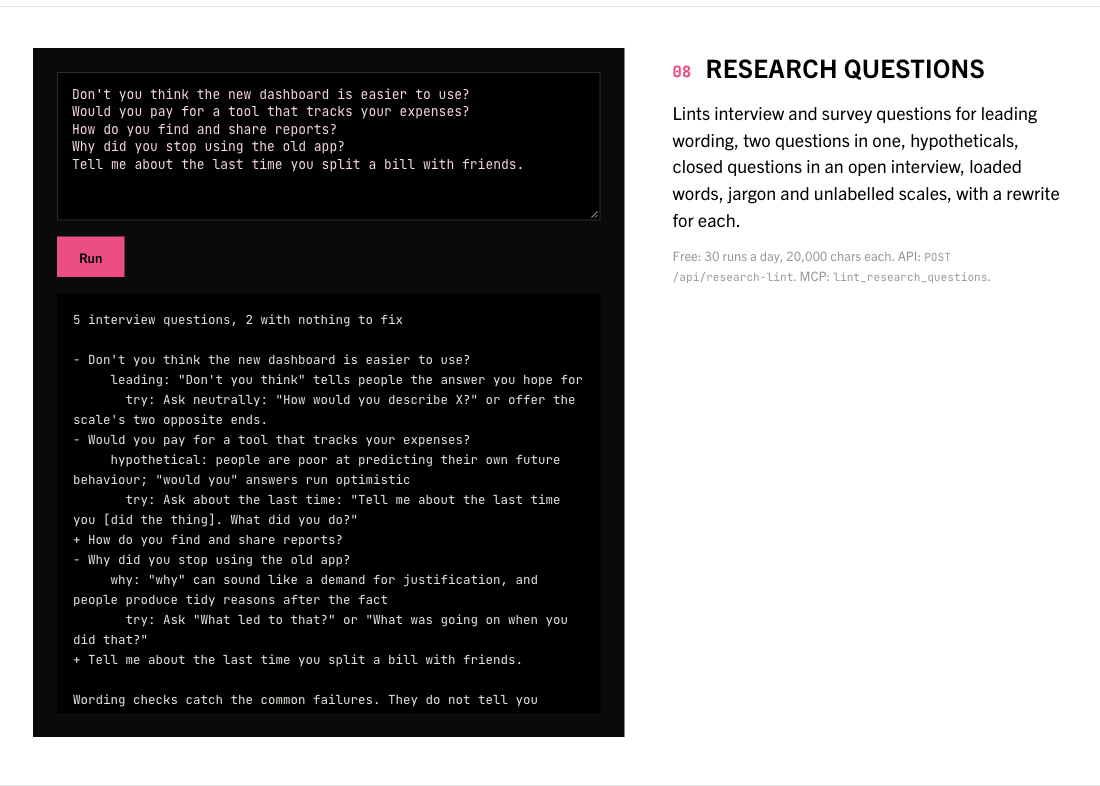
Lints interview and survey questions for leading wording, two questions in one, hypotheticals, closed questions in an open interview, loaded words, jargon and unlabelled scales, with a rewrite for each.
MCP tool name: lint_research_questions. REST: POST /api/research-lint. Free: 30 runs a day per IP, 20,000 characters each. Pro: no cap.
Ask for it in plain words
Lint user research questions, one per line, for leading wording, double-barrelled questions, hypotheticals, predictions, loaded words, jargon, closed questions in an open interview, why-questions and unlabelled rating scales, with a suggested rewrite for each problem.
Inputs
| Name | Type | Meaning |
|---|---|---|
text * | string | One question per line |
mode | string (interview, survey) | Default interview |
* required
Example
curl -X POST https://designers.allthepossibles.com/api/research-lint \
  -H "content-type: application/json" \
  -d '{"text":"Don'\''t you think the new dashboard is easier to use?\nWould you pay for a tool that tracks your expenses?\nHow do you find and share reports?\nWhy did you stop using the old app?\nTell me about the last time you split a bill with friends."}'
Example output
The report field, for the input above (structured fields come back alongside it):
5 interview questions, 2 with nothing to fix

- Don't you think the new dashboard is easier to use?
     leading: "Don't you think" tells people the answer you hope for
       try: Ask neutrally: "How would you describe X?" or offer the scale's two opposite ends.
- Would you pay for a tool that tracks your expenses?
     hypothetical: people are poor at predicting their own future behaviour; "would you" answers run optimistic
       try: Ask about the last time: "Tell me about the last time you [did the thing]. What did you do?"
+ How do you find and share reports?
- Why did you stop using the old app?
     why: "why" can sound like a demand for justification, and people produce tidy reasons after the fact
       try: Ask "What led to that?" or "What was going on when you did that?"
+ Tell me about the last time you split a bill with friends.

Wording checks catch the common failures. They do not tell you whether you are asking the right question, or whether the people you are asking are the right people.
What it looks like
Limits of this tool
Wording checks catch common failures; they cannot tell you whether you are asking the right people the right question.