Tools / Critique plan
Critique plan Free
A critique agenda for the stage your design is in: framing statement, timed rounds, the questions that fit the stage, roles, and the feedback to turn away until the next stage.
MCP tool name: plan_critique. REST: POST /api/critique-plan. Free: 30 runs a day per IP. Pro: no cap.
Ask for it in plain words
Plan a 45 minute critique for a wireframe of our onboarding.
Plan a design critique for a stage (concept, wireframe, visual, prototype, build, shipped): a framing statement, timed agenda, the questions that fit the stage, roles, and the kinds of feedback to turn away until a later stage.
Inputs
| Name | Type | Meaning |
|---|---|---|
description * | string | A sentence or two about the design |
stage * | string (concept, wireframe, visual, prototype, build, shipped) | Where the work is now |
goal | string | What the design has to achieve |
audience | string | Who it is for |
minutes | integer | Session length, 15 to 120, default 30 |
* required
Example
curl -X POST https://designers.allthepossibles.com/api/critique-plan \
  -H "content-type: application/json" \
  -d '{"description":"a three-step onboarding flow for a budgeting app","stage":"wireframe","minutes":45}'
Example output
The report field, for the input above (structured fields come back alongside it):
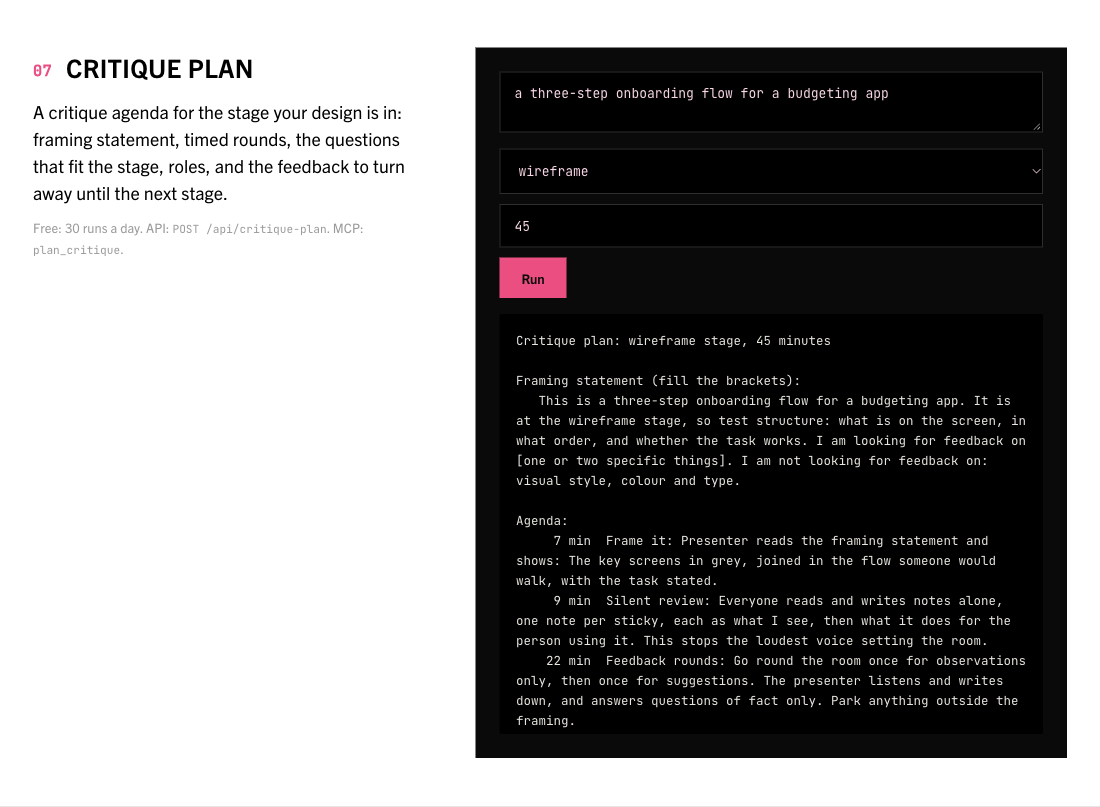
Critique plan: wireframe stage, 45 minutes

Framing statement (fill the brackets):
   This is a three-step onboarding flow for a budgeting app. It is at the wireframe stage, so test structure: what is on the screen, in what order, and whether the task works. I am looking for feedback on [one or two specific things]. I am not looking for feedback on: visual style, colour and type.

Agenda:
     7 min  Frame it: Presenter reads the framing statement and shows: The key screens in grey, joined in the flow someone would walk, with the task stated.
     9 min  Silent review: Everyone reads and writes notes alone, one note per sticky, each as what I see, then what it does for the person using it. This stops the loudest voice setting the room.
    22 min  Feedback rounds: Go round the room once for observations only, then once for suggestions. The presenter listens and writes down, and answers questions of fact only. Park anything outside the framing.
     7 min  Decide: Presenter reads back the three notes they will act on, and any they are setting aside with a reason. Name an owner and a date for each.

Questions that fit this stage:
   - Can you complete the task using only what is on these screens? Where did you hesitate?
   - What would you expect to happen after each action?
   - What is the most important thing on each screen, and is it the most prominent?
   - What is missing, and what is here that the task does not need?

Feedback to turn away at this stage:
   - Visual style, colour and type. Everything is grey on purpose.
   - Exact copy.
   - Animation and transitions.

Roles:
   - Presenter: frames and listens, does not defend.
   - Facilitator: holds the time, redirects off-topic feedback to the parking lot.
   - Note-taker: records what is said, in the speaker's words. The presenter should not be the note-taker.

Close with:
   - Which feedback are we acting on, and who owns each item?
   - Which feedback did we set aside, and why?
   - What do we need to learn before the next review, and how?
What it looks like
Limits of this tool
Deterministic: the same input always gives the same answer. It does not call a language model.